Original Carbonara Recipe Italian Easy: Authentic & Foolproof Guide
Quick Navigation
- Where Did Carbonara Even Come From? (A Quick History)
- The Unbreakable Rules of an Authentic Carbonara
- The Step-by-Step: Your Foolproof Original Carbonara Recipe Italian Easy
- Why Does My Carbonara Go Wrong? Troubleshooting Top Mistakes
- Answering Your Carbonara Questions (The FAQ)
- The Takeaway: Keep It Simple, Stupid
Let's be honest. You've probably had a "carbonara" that was a gloopy, cream-laden mess. I know I have. It's disappointing, right? You order it at a restaurant, excited for that authentic Italian taste, and what you get is a heavy, one-note sauce that sticks to the roof of your mouth. The real deal is something else entirely—a silky, elegant, and surprisingly simple emulsion of egg, cheese, and pork fat. It's magic in a bowl, and it's one of the easiest classic pasta dishes to get right, if you know the rules.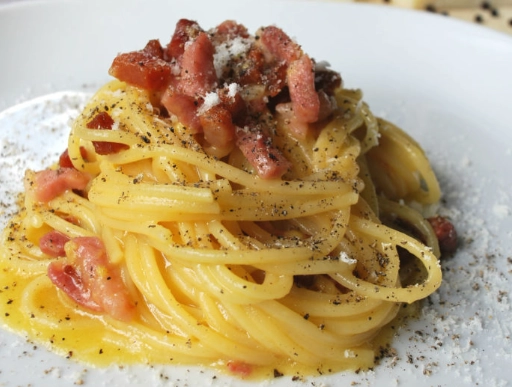
That's what we're here for. This isn't just another recipe. This is a deep dive into the original carbonara recipe Italian easy method that Romans would recognize. We'll strip it back to its essentials, bust the myths (goodbye, cream!), and walk you through each step so you can nail it every single time. Forget the complicated stuff. This is about simplicity and quality.
Where Did Carbonara Even Come From? (A Quick History)
Its origins are surprisingly murky. Unlike many ancient Roman dishes, carbonara is a 20th-century creation. The most popular theory links it to the carbonai—the charcoal workers in the Apennine mountains. They needed a hearty, non-perishable meal they could cook over a fire: eggs, hard cheese (like Pecorino), cured pork (guanciale), and dried pasta. It makes sense. Another theory suggests it was born post-World War II, when American soldiers brought their bacon and egg rations to Rome, and local chefs combined them with pasta. Honestly, I lean towards the charcoal worker story—it feels more rooted in the land. Whatever the true story, the result is a uniquely Roman dish that's become a global icon. For a deeper look into its debated history, the Academia Barilla, a respected institution dedicated to Italian gastronomic culture, has some interesting research on pasta's evolution.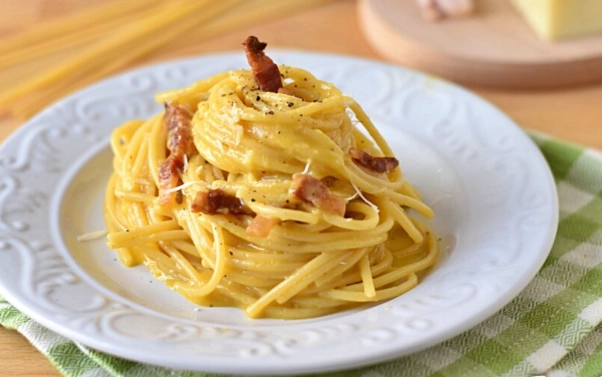
But here's the thing. Knowing the history isn't just trivia. It informs the original carbonara recipe Italian easy philosophy: use what's available, keep it simple, and let a few great ingredients shine. That's the heart of it.
The Unbreakable Rules of an Authentic Carbonara
Before we touch a pan, let's get the dogma out of the way. Break these, and you're making something delicious, perhaps, but it's not a true carbonara. Think of this as your checklist for authenticity.
Now, the positive rules—the things you must have.
The Core Four Ingredients (Non-Negotiable)
This is the holy quartet. Their quality directly determines your success.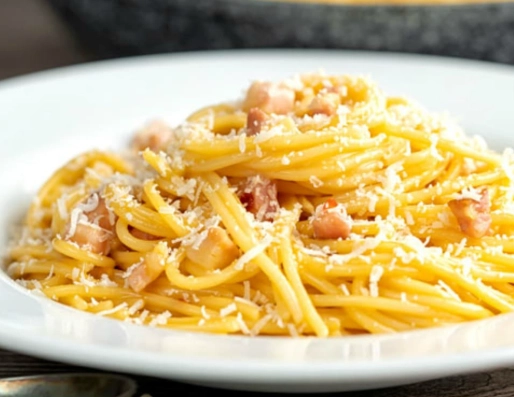
| Ingredient | Authentic Choice | Why It Matters | Acceptable Substitute (In a Pinch) |
|---|---|---|---|
| Pasta | Spaghetti or Rigatoni | Long, thick shapes like spaghetti hold the sauce perfectly. Rigatoni's ridges trap the creamy bits. Dried pasta is traditional and preferred for its texture. | Bucatini, Tonnarelli |
| Pork | Guanciale (cured pork cheek) | This is the star. Guanciale has a richer, more complex fat and a more tender texture than pancetta. It renders beautifully and gives carbonara its signature flavor. This is where the magic starts. | Pancetta (Italian cured pork belly). Avoid lean bacon—it's too smoky and sweet. |
| Cheese | Pecorino Romano (sheep's milk) | Sharp, salty, and tangy. Pecorino is the traditional Roman cheese. It melts into the sauce with a distinct bite that Parmigiano-Reggiano alone can't replicate. | A 50/50 mix of Pecorino and Parmigiano-Reggiano for a slightly milder, rounded flavor. |
| Eggs | Fresh, large eggs (yolks are key) | They create the sauce. The yolks provide richness, color, and the base for the emulsion. Freshness is critical for food safety and flavor. | None. Get good eggs. |
See? Just four things. Finding guanciale might require a trip to a proper Italian deli or an online order, but trust me, it's a game-changer. The difference in flavor is night and day. If you're curious about the official protection and standards for traditional Italian ingredients like Pecorino Romano, you can check the GUARDIA DEL GUSTO consortium, which works to protect and promote authentic Italian food products.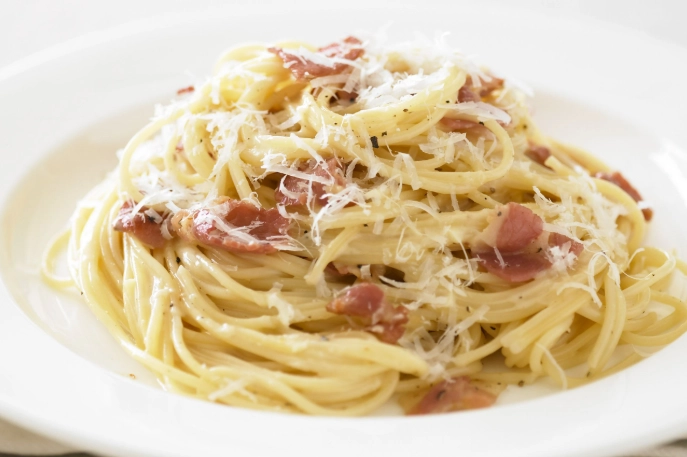
The Step-by-Step: Your Foolproof Original Carbonara Recipe Italian Easy
Alright, let's cook. This is where the "easy" part truly comes to life. The process is about timing and temperature control, not complex techniques.
Step 1: Prep Like a Pro (Mise en Place is Everything)
Carbonara comes together fast. Have everything ready before you turn on the stove.
- Cube the Guanciale/Pancetta: Cut into 1/2-inch thick strips, then into small cubes or lardons. You want a good mix of meat and fat pieces.
- Grate the Cheese: Finely grate your Pecorino (or cheese mix). Do not use pre-grated cheese—it contains anti-caking agents that prevent it from melting smoothly into the sauce. This is a huge, common mistake.
- Prepare the Egg Mixture (The "Cream"): In a large, room-temperature bowl (not the serving bowl yet), whisk together 4 large egg yolks and 1 whole egg. Yes, mostly yolks! This is the secret to a rich, yellow, creamy sauce without being eggy. Then, vigorously whisk in all of your grated cheese until it forms a thick, grainy paste. Add a generous amount of coarsely ground black pepper. Set this bowl aside. No salt yet! The guanciale and cheese are very salty.
- Start the Pasta Water: Fill a large pot with water, salt it generously once it boils (it should taste like the sea), and get it ready for your pasta.
Step 2: Render the Pork & Cook the Pasta (The Dance Begins)
Now we start the two simultaneous tracks.
Track A: The Guanciale. In a cold, large skillet (I use stainless steel or carbon steel), add your cubed guanciale. Turn the heat to medium-low. You want to render the fat slowly, gently frying the meat until it's golden brown and crispy, but not burnt or dried out. This should take about 10-12 minutes. Once done, turn off the heat. You should have a lovely pool of fragrant fat and crispy meat bits. Leave it all in the pan.
Track B: The Pasta. Drop your spaghetti into the boiling water and cook it 1-2 minutes less than the package says. We're going to finish it in the pan, so it needs to be very al dente.
Step 3: The Magic Emulsion (Don't Scramble the Eggs!)
This is the moment of truth. The goal is to cook the egg mixture with residual heat, not direct flame, to create a creamy sauce, not scrambled eggs.
- When the pasta is ready, use tongs to transfer it directly from the pot into the skillet with the guanciale and fat. Do not drain it into a colander! We need that starchy pasta water. A little water clinging to the pasta is perfect.
- Turn the skillet heat back on to very low. Toss the pasta vigorously in the fat for a minute or two, letting it drink up the flavor and finish cooking. If it looks dry, add a small splash of the starchy pasta water from the pot.
- Now, take the skillet off the heat entirely. Let it cool for just 30 seconds. This is crucial—we need to temper the egg mixture.
- Working quickly, pour about 1/4 cup of the hot pasta water into your bowl of egg and cheese paste. Whisk it immediately. This loosens the mixture and starts warming it up.
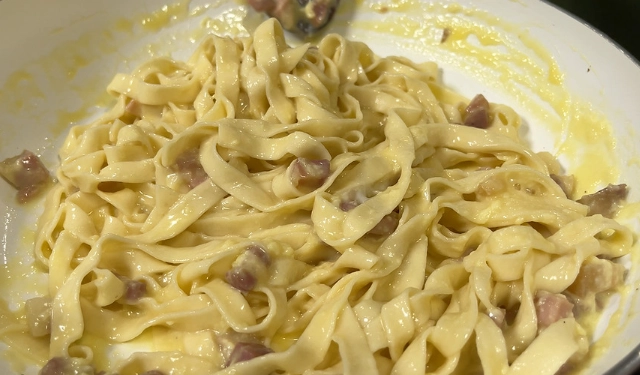
- Now, slowly pour the tempered egg/cheese mixture into the skillet with the pasta and guanciale, while constantly tossing and stirring with tongs. The residual heat from the pasta and pan will gently cook the eggs into a glossy, creamy sauce that coats every strand. If it seems too thick, add more pasta water, a tablespoon at a time, until it flows silkily.
The sauce should look like a rich, golden velouté. It should not be clumpy or look like fried eggs. If you see curds forming, you added the eggs to a pan that was too hot. Don't worry, it still tastes good, but the texture is off. Practice makes perfect.
Why Does My Carbonara Go Wrong? Troubleshooting Top Mistakes
We've all been there. Let's diagnose the common disasters.
- Sauce is Scrambled/Grainy: The pan was too hot when you added the egg mixture. Always remove from heat and let it cool slightly. The pasta water tempering step is your best friend.
- Sauce is Too Thick/Claggy: You didn't use enough pasta water. That starchy water is the magic liquid that helps emulsify the sauce and get it to the right consistency. Don't be shy with it.
- Dish is Too Dry: Likely not enough rendered fat from the pork and/or not enough pasta water added during the final toss. The sauce needs to be "loose" when you plate it, as it will set slightly.
- Dish is Bland: You probably didn't season the pasta water enough, or you used inferior cheese. The salt from the water, guanciale, and Pecorino is the primary seasoning. Also, black pepper is not just a garnish—it's a core flavor component. Use a lot, freshly ground.
- Guanciale is Tough or Burnt: You started with a hot pan or had the heat too high. Always start cold and render slowly.
Answering Your Carbonara Questions (The FAQ)
Can I use bacon?
You can, but it won't be authentic. American bacon is smoked and often sweetened (maple, brown sugar), which completely changes the flavor profile of the dish. It becomes an American pasta dish, not a Roman one. Pancetta is the bare minimum substitute.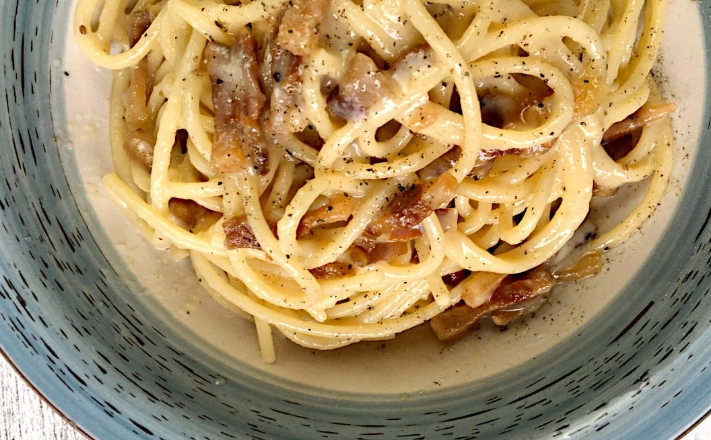
Why no cream? Everyone adds cream!
Because it's unnecessary and masks the true flavor. The creaminess in a real original carbonara recipe Italian easy comes from the emulsion of fat, starch, and egg. It's a lighter, more refined texture. Adding cream is a shortcut that covers up mistakes (like scrambling eggs) but results in a heavier, less interesting sauce. It's the difference between a delicate custard and a thick pudding.
Is it safe to eat raw eggs?
The eggs are cooked by the residual heat of the pasta. They reach a temperature high enough to thicken and be safe, but not so high that they scramble. Using very fresh, high-quality eggs from a trusted source minimizes any risk. If you're pregnant, immunocompromised, or concerned, you can look for pasteurized-in-shell eggs.
Can I make it ahead of time?
Honestly, no. Carbonara is a dish that must be eaten immediately. It doesn't reheat well (the sauce breaks), and it certainly shouldn't sit. It's the ultimate last-minute meal. The whole process, from cold pan to plate, is under 20 minutes. That's part of what makes this an easy Italian carbonara—it's fast!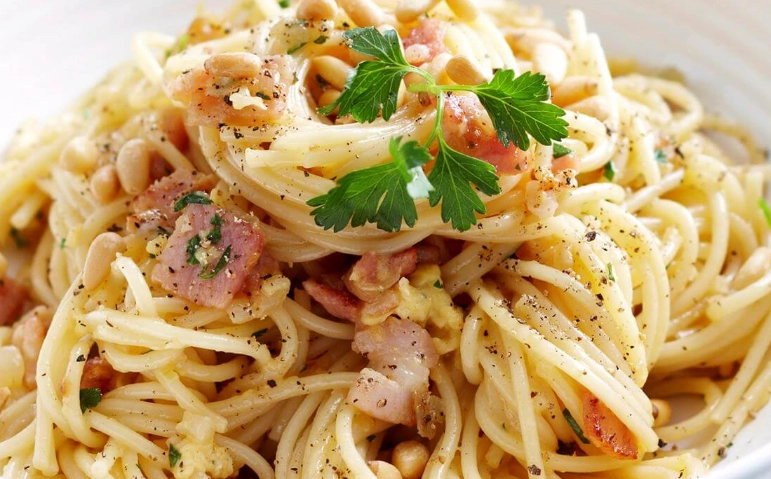
What wine do I pair with it?
You want something that can cut through the richness. A dry white wine from Lazio, like a Frascati or a Marino, is the classic local pairing. A light-bodied red like a young Chianti or a Montepulciano d'Abruzzo also works beautifully. For more on Italian food and wine pairing principles, resources from the Italian Food Excellence network can offer great insights.
The Takeaway: Keep It Simple, Stupid
That's the mantra. The beauty of the original carbonara recipe Italian easy lies in its restraint. Four ingredients. One simple technique. A focus on quality. When you stop trying to "improve" it with garlic, onions, cream, or peas (don't get me started on peas), you discover a dish that's far greater than the sum of its parts.
Go on, give the real authentic carbonara recipe a shot. Your taste buds will thank you.
Related Articles
Traditional Italian Dinner Party Recipes: An Authentic Menu from Start to Finish
Traditional Southern Italian Recipes: Authentic Dishes & Secrets
Italian Vinaigrette Recipe: The Only Guide You'll Ever Need

The largest IPO in the A-share market in 13 years has been terminated, and it wa
Traditional Italian Salad Names: A Guide to Authentic Recipes & History